

TXSTMcCOY MAGAZINE
Accounting
for Impact
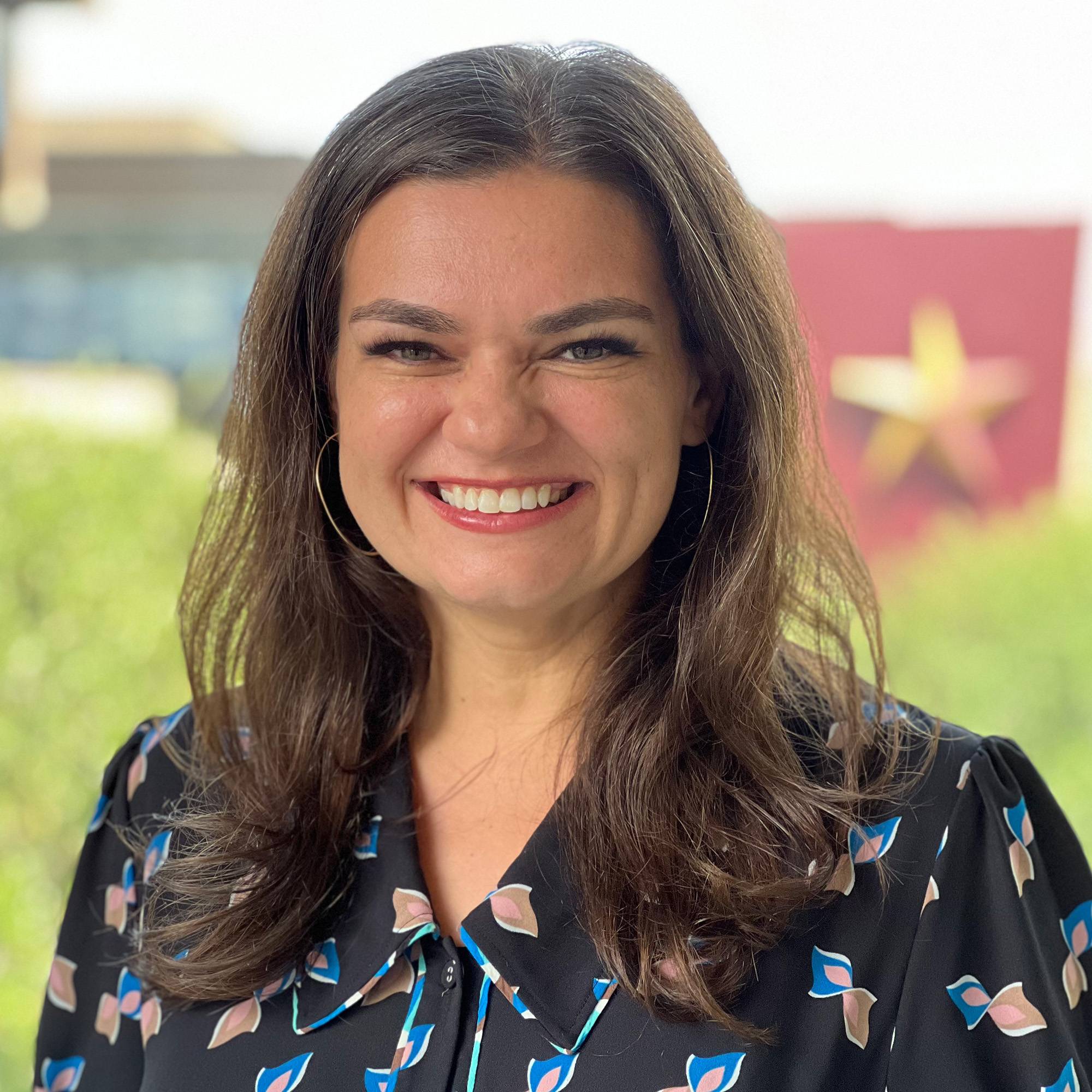
Dr. Amanda Lester shows students how sustainability is transforming accounting
by Valerie Figueroa
Long before Dr. Amanda “Mandy” Lester became an assistant professor of accounting at Texas State University’s McCoy College of Business, she was the kind of kid who asked for extra workbooks over the summer and lined up her stuffed animals to teach them. With two educators for parents and an early interest in school, teaching was a natural fit for Lester. Her passion for accounting came later, and eventually, she realized that the field could offer a powerful way to understand how businesses communicate.
“It's the language that businesses speak to communicate economic performance and risk,” she says.
Lester earned her BBA and master of professional accounting (MPA) from the University of Texas at Austin (UT Austin), became a CPA and CIA, and spent nearly eight years in the industry before returning to her alma mater to pursue her Ph.D.
“My experience in practice allows me to bring real-world context into the classroom, which ultimately makes me a more effective educator,” she says.
Along the way, Lester was influenced by UT Austin professors Lisa Koonce, Brian White, and Jeffrey Hales — who is a former Sustainability Accounting Standards Board (SASB) chair and current International Sustainability Standards Board (ISSB) member — and developed her interest in sustainability accounting while serving as a teaching assistant for Hales’ course.
“He's been at the forefront of sustainability research and standard setting for many years,” Lester says. “My background in accounting standards naturally led me to sustainability reporting, where many of the same questions around measurement, recognition, and disclosure take on new complexity.”
A New Course
At McCoy College, Lester’s research examines how companies communicate sustainability-related risks and opportunities, and how those disclosures influence decision-making by investors and managers.
“Businesses have traditionally focused on financial risks,” Lester says. “But sustainability factors can reveal exposures that aren’t always visible in the numbers, even though they shape the organization’s overall health and long-term performance.”
Lester is also helping her students prepare for an industry that is evolving in real time.
She is developing a new course in sustainability-informed accounting, which will launch next spring. The course builds on one originally developed by Hales at UT Austin, where Lester served as a teaching assistant and worked closely with students. The course drew strong interest from students across disciplines, not just accounting majors. Lester says the curriculum evolved almost weekly, adapting to shifting standards and an increasingly complex regulatory landscape.
She describes the course as an exercise in applied learning. The curriculum includes studying sustainability standards, examining real company reports, and comparing disclosures across firms in the same industry to identify gaps, weaknesses, and opportunities for improvement. Guest speakers and current events will also play a major role, helping students connect technical concepts to the rapidly changing business landscape.
She emphasizes the importance of understanding how sustainability-focused measures influence how businesses are perceived by customers, employees, and partners.
“Sustainability issues were once viewed as external to the firm,” she says. “Increasingly, they are recognized as factors that directly affect risk, performance, and firm value.”
Several sustainability reporting frameworks guide companies in transparently disclosing their environmental, social, and governance (ESG) performance to stakeholders, including the ISSB, established by the International Financial Reporting Standards Foundation (IFRS), the SASB, which now operates under the IFRS Foundation, and the Global Reporting Initiative (GRI).
Still, establishing consistent measurement standards remains a challenge, particularly when evaluating sustainability efforts across industries and how companies report them.
“A grocer faces very different sustainability risks than an oil and gas company,” she says. “That’s why reporting standards are tailored by industry, so the information is meaningful in each context.”
“My experience in practice allows me to bring real-world context into the classroom, which ultimately makes me a more effective educator.”
— Dr. Mandy Lester
Supporting the Future Workforce
Lester’s commitment to teaching drew her to Texas State.
As a Hispanic-Serving Institution with many first-generation students, Texas State stood out for its hardworking, community-minded students and its growth as a research university.
“The university’s Run to R1 initiative reflects a significant investment in research,” she says of the university’s research-focused initiative that aims to increase research expenditures, grow doctoral programs, and attract top-tier research faculty. “It’s creating meaningful opportunities for our students, and I’m excited to be part of that growth.”
She currently has several working papers underway, including studies on how investors respond to emotion-laden sustainability disclosures, how disclosure requirements shape managers’ decisions around climate-related analysis, and how communities interpret tax disclosures. She is also interested in future interdisciplinary work, particularly around supply chains, labor, and nature-related sustainability risks.
Despite the energy she brings to research, Lester says some of the most meaningful moments in her work come from students.
“I am continually impressed by our students,” she says. “They are kind and curious, and I'm inspired by them every day.”
She smiles as she talks about helping students prepare resumes, practice interviews, apply for internships, and build their confidence. For Lester, those moments matter as much as any career milestone.
“I find it especially meaningful to work with students as they make important decisions about their careers and future direction,” she says.
Outside of the classroom, Lester enjoys time with family, travel, and the outdoors. She and her husband, Bryan, have two daughters, Makena and Ava, who keep her inspired in much the same way her students do.
For students interested in careers at the intersection of accounting and sustainability, her advice is to start early, stay curious, and pay attention to where the field is headed.
“The opportunities are there,” she says.
Lester is helping students understand what those opportunities look like and how accounting can be used to interpret how business shapes the world, and how the world, in turn, shapes business. ✯
Dr. Mandy Lester
Assistant Professor of Accounting
Ph.D., University of Texas at Austin, 2024
MPA, University of Texas at Austin, 2010
BBA, University of Texas at Austin, 2010
Research Interests
- Sustainability Disclosure
- Investor Judgment and Decision-Making
- Standard Setting
Valerie Figueroa is the communications specialist at the McCoy College of Business. Valerie earned a B.S. in mass communication and an M.A. in mass communication at Texas State University.